
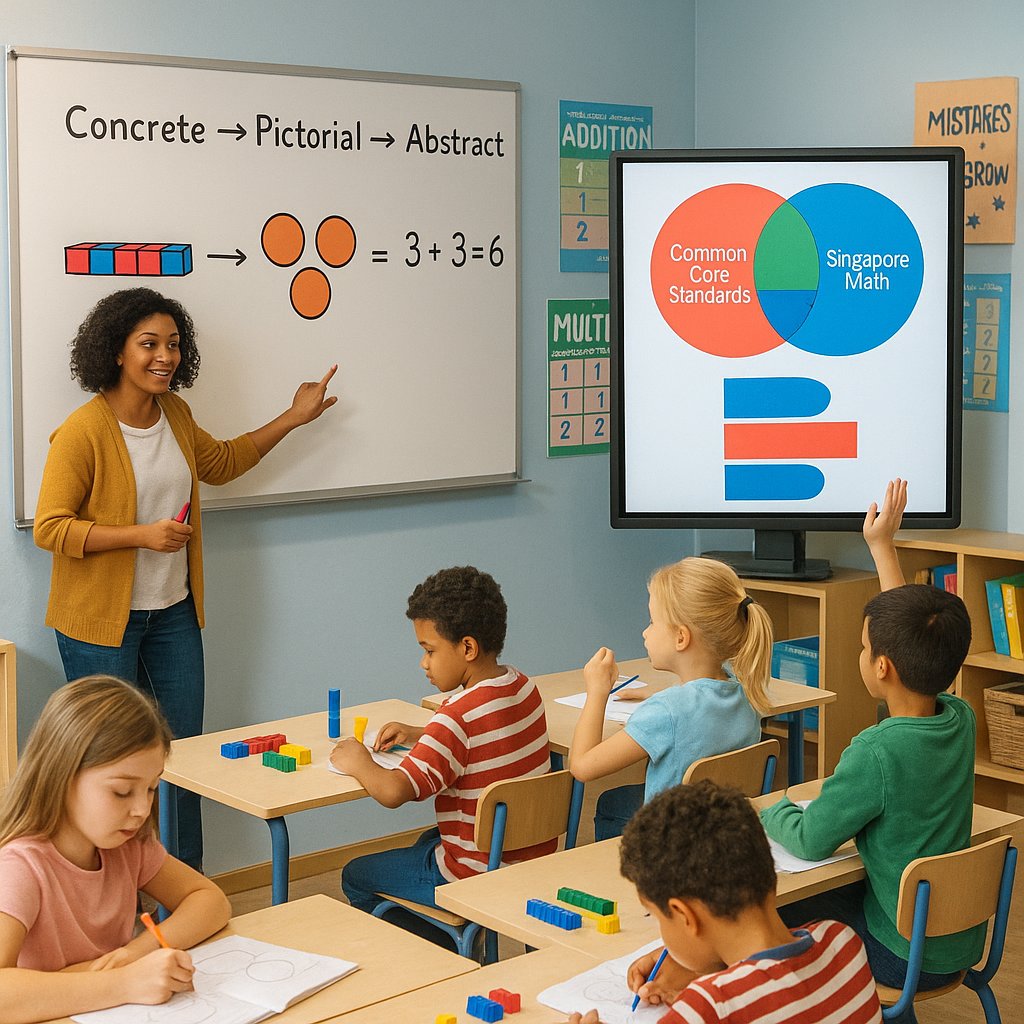
As a math educator, I have heard parents ask, "How does Singapore Math compare to the Common Core?" The truth is both approaches set high expectations for student learning. They share some core strengths but differ in how they are structured, how much guidance they give teachers, and how topics are taught.
The United States created the Common Core State Standards (CCSS) in 2010 to provide more consistent learning goals for K-12 math and English education. The idea was that no matter which state or school a child attended, there would be a shared "final destination" for what students should know and be able to do at each grade level.
Importantly, the CCSS are a framework, not a curriculum. They set the goals but do not prescribe the exact lessons, activities, or textbooks to reach them. This gives schools and teachers flexibility to select or design their own materials, as long as they meet the standards.
This is why you may see some U.S. schools using Singapore Math while still adhering to the Common Core. One is a set of standards (CCSS), while the other is a full curriculum and teaching method.
Singapore Math originates from Singapore's national math curriculum, which was developed in the 1980s and has been refined over decades. It is both a curriculum and a teaching approach known for its Concrete to Pictorial to Abstract progression:
This method builds a deep understanding of concepts, strong problem-solving skills, and flexible number sense. Lessons are carefully sequenced so each concept builds directly on previous learning, with fewer topics per grade but much greater depth.
The Common Core State Standards leave teaching methods open to interpretation and ultimately stress procedural fluency, conceptual understanding, and application of concepts. Because CCSS tells teachers what to teach but not how, it is possible, and often beneficial, to teach the standards using the Singapore Math approach. Teachers can take the rigorous problem solving and visual models from Singapore Math and align them with Common Core standards.
Both approaches share some key priorities:
The main difference lies in scope vs. depth:
Both systems stress the importance of problem solving. Math is not just about memorizing steps, it is about thinking critically, recognizing patterns, and applying knowledge to new situations. In this way, both the CCSS and Singapore Math help students develop the skills they will need not only for future math classes but also for real-world problem solving.
Whether your child's school follows Common Core, Singapore Math, or a blend, success depends on how learning is delivered and reinforced. StarSpark works alongside any approach, adapting in real time to your child's skill level, pace, and learning style.
Our AI-powered teacher aligns every lesson to grade-level standards while integrating core principles found in Singapore Math: logical sequencing, mastery-focused practice, and rigorous problem solving. Students get targeted practice and step-by-step guidance following the Socratic teaching method that strengthens critical thinking skills and closes knowledge gaps along the way.
The result? Students do not just meet grade-level benchmarks. They truly understand the "why" behind the math, develop the confidence and skills to tackle new problems, connect concepts across topics, and think critically. This kind of understanding sticks, giving them the ability to apply what they have learned in the classroom and in real life for years to come.
See the StarSpark impact today by starting your 14-day free trial.
Written by Meg Knapik, educator and former Assistant Superintendent of Curriculum and Instruction.
Start learning with StarSpark today.
Free for 14 days, no credit card needed.