

A cell sits in a hypertonic solution. Does it swell or shrink?
If you said swell, that's the trap. "Hyper" sounds like more, bigger, extra. But the cell shrinks. This guide gives you one rule that settles hypertonic vs hypotonic every time, plus what happens to animal and plant cells, a quick look at water potential, and practice questions.
What's in this guide:
Osmosis is the movement of water across a selectively permeable membrane. The membrane lets water through but limits the solutes. So instead of the solutes spreading out, the water moves. It moves from the side with lower solute concentration to the side with higher solute concentration. Put simply, water moves toward more solute.
Tonicity is how a solution outside a cell changes the cell's volume through osmosis. The cell's cytoplasm is always the reference point. In the AP Biology course, this sits in Unit 2 under Topic 2.7, Tonicity and Osmoregulation. For the full unit, see our AP Biology Unit 2 review.
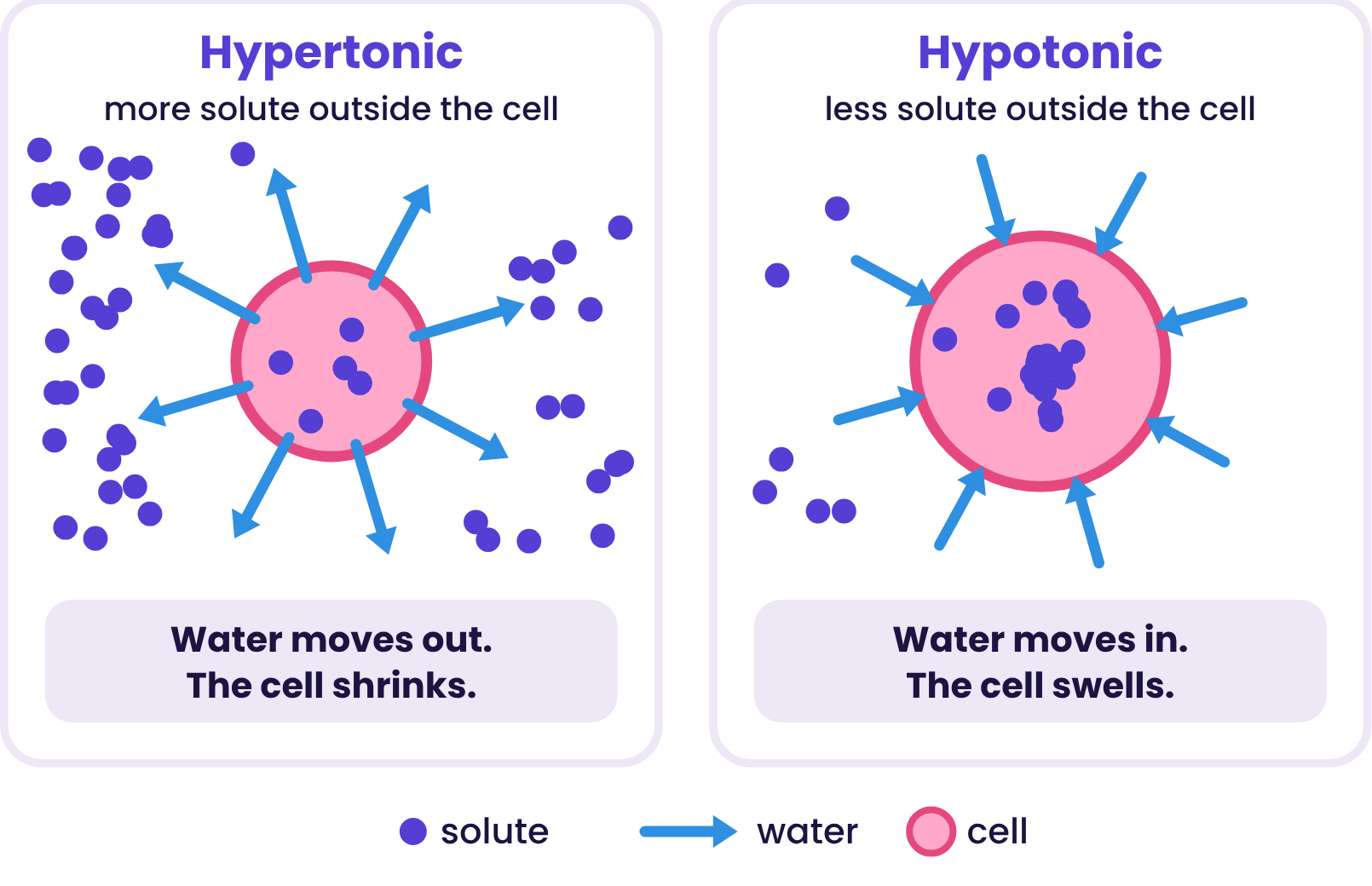
A quick way to remember the prefixes: "hyper" means over, like hyperactive. "Hypo" means under, like hypothermia. Then attach each one to the solution outside, not to the cell.
Most mistakes come from reading the prefix as a description of the cell. "Hypertonic" sounds like the cell is getting bigger. It's not. The word is about the solution the cell is sitting in.
Ask two things, in this order:
Try it on the opening question. A hypertonic solution has more solute outside. Water moves out, toward the solute. The cell shrinks.
Now flip it. Put a red blood cell in pure water. Pure water has less solute than the cell, so it's hypotonic. Water moves in, toward the solute inside. The cell swells and can burst.
⚠ Watch out for:
These terms are always a comparison. A solution isn't hypertonic on its own. It's hypertonic to something. If a question compares two solutions, find which one has more solute, then send the water that way.
The cell wall changes what happens, so learn both cases.
Animal cells (no cell wall):
Plant cells (rigid cell wall):
Notice the twist. Hypotonic is dangerous for an animal cell but it's what a plant cell wants.
AP Biology also describes osmosis with water potential, written with the Greek letter psi (Ψ). Two facts get you most of the way:
That's the same rule in different words. More solute means lower water potential, and water moves toward it.
These examples come from OpenStax Biology 2e. They're worth knowing because free-response questions often ask you to explain a cell's response, not just name it.
Use the rule: where is there more solute? Water moves that way.
Answers: 1. Hypotonic. Water enters and the cell can burst (lysis). 2. The solution is hypertonic. Water leaves, the membrane pulls away from the wall (plasmolysis). 3. Into the cell, toward the higher solute concentration. The outside solution is hypotonic. 4. From A to B, from higher to lower water potential. 5. Water keeps flowing in, so the vacuole pumps it out to stop the cell from bursting.
Want more practice? Paste these questions into StarSpark to generate a full quiz with explanations.
Tonicity is one piece of Unit 2. The full review covers cell structure, cell size, the plasma membrane, membrane transport and compartmentalization, with flashcard and quiz prompts for each topic. The 2027 AP Biology exam is on Monday, May 3, 2027.
For official AP Biology resources, visit apcentral.collegeboard.org.
AP is a registered trademark of the College Board, which was not involved in the production of this guide.
Start learning with StarSpark today.
Free for 14 days, no credit card needed.