
Unit 9 combines two big concepts: thermodynamics (whether reactions are favored) and electrochemistry (reactions involving electron transfer). You'll learn about entropy and Gibbs free energy, which predict whether reactions will proceed. Then you'll apply these ideas to electrochemical cells where electrons flow and electrical energy is generated or consumed. These concepts connect everything you've learned: equilibrium, reaction rates, acid-base chemistry, and energy.
Unit 9 makes up about 7-9% of the AP Chemistry exam. Focus your energy on these priorities:
What's in this review:
Entropy measures the dispersal or disorder in a system. It's a fundamental property that tells you about the number of ways particles can be arranged or the distribution of energy among them. Entropy increases when matter becomes more dispersed. For example, when a solid melts to a liquid, the particles can move more freely and occupy more space, so entropy increases. When a liquid vaporizes to a gas, the particles spread out even more and entropy increases further.
Entropy also increases with temperature. At higher temperatures, the kinetic energy of particles is more broadly distributed, increasing the number of ways energy can be distributed among the particles. Additionally, when gases are produced from liquids or solids in a reaction, or when the number of moles of gas increases, entropy typically increases.
You don't need to calculate absolute entropy values from first principles. You'll use tabulated entropy values (absolute entropies) to calculate entropy changes for reactions. The key concept is understanding what causes entropy to increase or decrease.
Key concepts to know:
⚠ Watch out for:
Entropy is not the same as disorder in the everyday sense. Entropy is a thermodynamic property, not just a visual measure of messiness. Focus on dispersal of matter and energy. Also, entropy change depends only on the initial and final states, not on the path taken.
Unlike enthalpy, we can define absolute entropy. Absolute entropy is the entropy relative to a perfect crystal at 0 K, where entropy = 0. Absolute entropy values are tabulated for many substances. You use these values to calculate entropy change for a reaction using:
ΔS°reaction = Σ(S° products) - Σ(S° reactants)
Just like with enthalpy, you multiply each entropy by the stoichiometric coefficient. Positive ΔS means entropy increases (disorder increases). Negative ΔS means entropy decreases (disorder decreases).
Key concepts to know:
⚠ Watch out for:
Don't forget the stoichiometric coefficients. If a substance has a coefficient of 2, multiply its entropy by 2. Also, entropy is in units of J/(mol·K), not kJ/(mol·K). Watch your units.
Gibbs free energy (G) combines enthalpy and entropy to predict whether a reaction is thermodynamically favored. The relationship is:
ΔG° = ΔH° - TΔS°
If ΔG° < 0, the reaction is thermodynamically favored. Products are favored at equilibrium. If ΔG° > 0, the reaction is not favored. Reactants are favored at equilibrium. If ΔG° = 0, the system is at equilibrium.
Key insight: Some reactions are favored by enthalpy (exothermic, ΔH° < 0) and entropy (ΔS° > 0). These are always favored. Some reactions are disfavored by both. These are never favored. Some reactions are favored by one but not the other. Temperature determines the outcome. For example, at low temperature, a small favorable entropy term is overcome by an unfavorable enthalpy term. At high temperature, entropy dominates.
The standard Gibbs free energy of formation (ΔGf°) can be used to calculate ΔG° for a reaction:
ΔG°reaction = Σ(ΔGf° products) - Σ(ΔGf° reactants)
Key concepts to know:
⚠ Watch out for:
Temperature is in Kelvin, not Celsius. Watch units on entropy (J vs. kJ). Also, "thermodynamically favored" means ΔG° < 0, but it doesn't mean the reaction happens quickly. That's kinetics. Thermodynamics predicts where equilibrium is, not how fast you get there.
Just because ΔG° < 0 doesn't mean a reaction happens immediately. The reaction might have a very high activation energy. The reaction is thermodynamically favored (ΔG° < 0) but under kinetic control because the activation energy is too high for the reaction to proceed at a measurable rate.
For example, the conversion of diamond to graphite is thermodynamically favored at room temperature, but diamonds don't spontaneously turn into graphite because the activation energy is too high. This is kinetic control.
It's important to distinguish: if ΔG° > 0, the reaction is not thermodynamically favored and will not proceed to a significant extent regardless of the activation energy. A low activation energy just means the system reaches its (unfavorable) equilibrium faster. Kinetics determines how quickly equilibrium is reached, but thermodynamics determines where that equilibrium lies.
Key concepts to know:
⚠ Watch out for:
Just because a reaction is thermodynamically favored doesn't mean it will happen. Check the activation energy. This is why catalysts are important: they lower activation energy without changing ΔG°. This allows thermodynamically favored reactions to proceed at useful rates.
At equilibrium, ΔG = 0. Before equilibrium, ΔG < 0 if the system is shifting toward products, and ΔG > 0 if the system is shifting toward reactants.
The relationship between ΔG° and K is:
ΔG° = -RT ln K
This is powerful: it relates the standard free energy change to the equilibrium constant. If ΔG° < 0, then K > 1 (products favored). If ΔG° > 0, then K < 1 (reactants favored). If ΔG° = 0, then K = 1.
For a reaction with K >> 1, ΔG° is very negative. The equilibrium lies far toward products. For a reaction with K << 1, ΔG° is very positive. The equilibrium lies far toward reactants. For K ≈ 1, ΔG° ≈ 0. The equilibrium shows comparable amounts of reactants and products.
Key concepts to know:
⚠ Watch out for:
This equation is different from ΔG = ΔG° + RT ln Q. The one here (ΔG° = -RT ln K) relates standard values. The other is for non-standard conditions. Know both and when to use each.
When a salt dissolves, ΔG° for dissolution reflects several competing factors: breaking intermolecular forces in the solid, reorganizing the solvent, and intermolecular interactions between dissolved ions and solvent. These can partially cancel each other out, making it difficult to predict whether a dissolution is favored without experimental data.
Some salts are very soluble because dissolution is thermodynamically favored (ΔG° < 0). Others have very low solubility because dissolution is not favored (ΔG° > 0). And some show complex behavior where solubility increases or decreases with temperature because ΔH° and TΔS° have different signs and magnitudes.
Key concepts to know:
⚠ Watch out for:
You can estimate the sign and magnitude of ΔH° and ΔS° for dissolution, but the exam expects qualitative reasoning rather than quantitative calculations. Understand the competing factors.
A coupled reaction pairs an unfavorable (ΔG° > 0) reaction with a favorable one (ΔG° < 0) so that the overall ΔG° < 0. External energy sources can drive unfavorable processes. In biology, ATP hydrolysis often drives unfavorable reactions. In electrochemistry, electrical energy drives unfavorable reactions in electrolytic cells.
When two reactions are coupled, their free energies add. If Reaction 1 has ΔG° = +200 kJ and Reaction 2 has ΔG° = -250 kJ, the overall process has ΔG° = -50 kJ and is favored overall.
Key concepts to know:
⚠ Watch out for:
The reactions must be coupled through a shared intermediate. Just adding ΔG° values for independent reactions doesn't make sense. The reactions must share products and reactants or a common substrate.
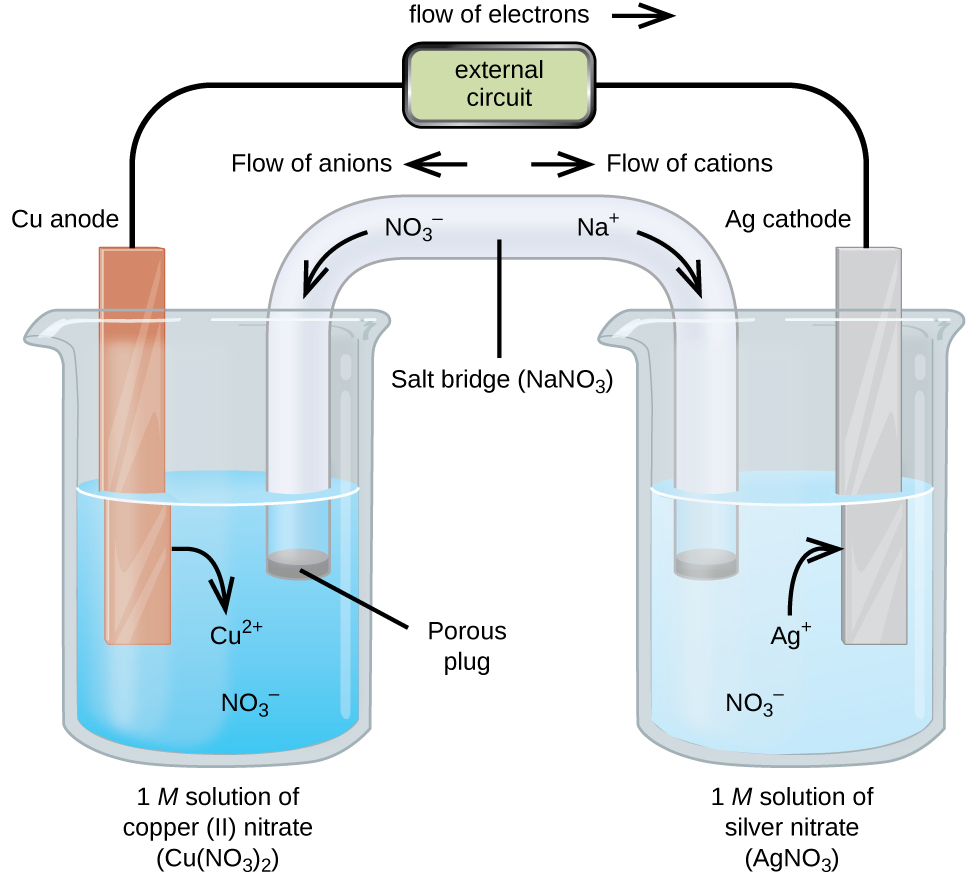
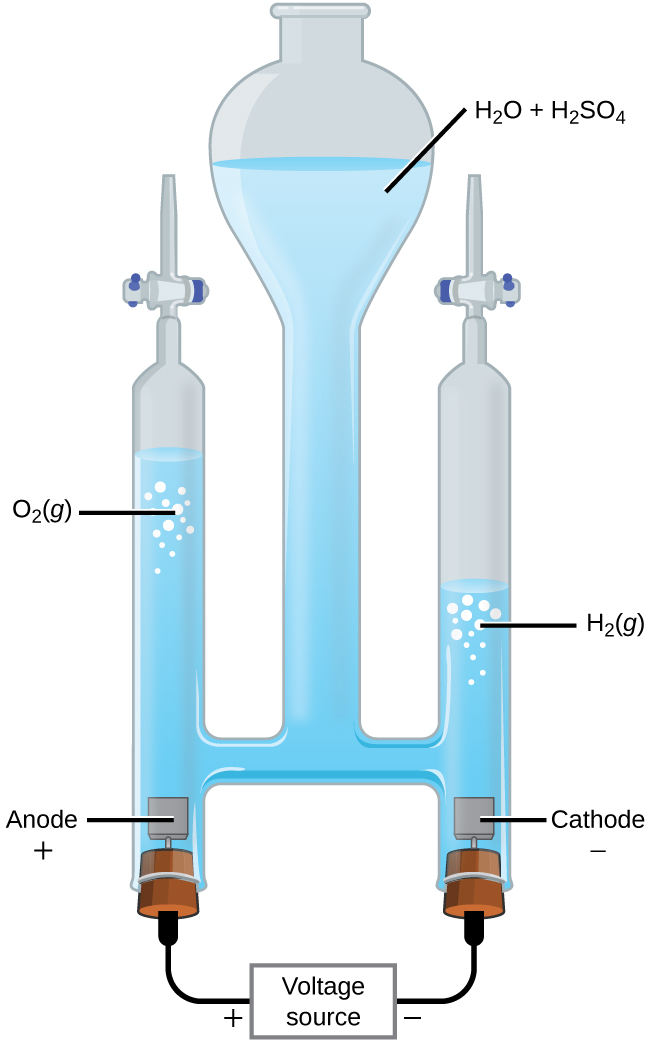
An electrochemical cell is a system where redox reactions occur. In a galvanic (or voltaic) cell, the redox reaction is thermodynamically favored (ΔG° < 0), so it occurs spontaneously and produces electrical energy. In an electrolytic cell, the redox reaction is not favored (ΔG° > 0), so electrical energy must be applied to make it happen.
Both types of cells have two half-cells connected by a salt bridge. The anode is where oxidation occurs. The cathode is where reduction occurs. This is true for both galvanic and electrolytic cells. The difference is which electrode is which in terms of the overall spontaneity.
In a galvanic cell, electrons are produced at the anode and consumed at the cathode. Electrons flow through an external wire from anode to cathode. Cations flow through the salt bridge from anode to cathode. At the cathode, reduction occurs. Ions are produced and released. At the anode, oxidation occurs. Ions are consumed. The circuit is completed by ion flow through the salt bridge.
Key concepts to know:
⚠ Watch out for:
The anode is where oxidation occurs, and the cathode is where reduction occurs, in both galvanic and electrolytic cells. But the polarity (positive or negative) varies between cell types. Don't confuse the definition with the polarity. The CED says not to label as positive or negative, so focus on oxidation and reduction locations.
The cell potential (E° for standard conditions) is the voltage produced by an electrochemical cell. It's directly related to spontaneity: a positive cell potential indicates a spontaneous (thermodynamically favored) reaction. A negative cell potential indicates a non-spontaneous reaction.
The relationship is: ΔG° = -nFE°
Where n is the number of electrons transferred, F is Faraday's constant (96,485 C/mol), and E° is the standard cell potential.
You calculate the cell potential by identifying the two half-reactions and finding their standard reduction potentials (E°red). The cell potential is:
E°cell = E°cathode - E°anode
Or equivalently:
E°cell = E°reduction - E°oxidation
A positive E°cell means the reaction is spontaneous. The larger the E°cell, the more favorable the reaction.
Key concepts to know:
⚠ Watch out for:
Standard reduction potentials in tables are always written as reductions. To calculate E°cell, use E°cathode - E°anode directly from the table values. You do not need to reverse the sign of a half-reaction's E° when it acts as the anode. The subtraction formula handles that automatically. Also, E° values don't change when you multiply stoichiometric coefficients, unlike ΔG°.
Under nonstandard conditions (concentrations other than 1 M, for example), the cell potential differs from E°. The relationship is given by the Nernst equation:
E = E° - (RT/nF) ln Q
This shows that the cell potential depends on Q (reaction quotient). When Q = 1 (standard conditions), the log term is zero and E = E°. When Q < 1, the log is negative and E > E°, meaning the cell drives the reaction forward. When Q > 1, the log is positive and E < E°, meaning the cell is closer to equilibrium.
As the cell operates and the reaction proceeds, Q increases and E decreases. At equilibrium, Q = K and E = 0. At this point, no more electrical energy can be extracted from the cell.
The direction of spontaneous electron flow in a concentration cell can be determined by comparing concentrations. Electrons flow to dilute the more concentrated solution and concentrate the more dilute solution, seeking equilibrium.
Key concepts to know:
⚠ Watch out for:
The CED says algorithmic calculations using the Nernst equation are not assessed. Focus on qualitative understanding. Know that E depends on Q, that E decreases as Q increases, and that E = 0 at equilibrium. You don't need to plug into the equation for the exam. Also note: Le Chatelier's principle should not be used to predict changes in cell potential or voltage of electrochemical cells. Use the Nernst equation relationship (qualitatively) between Q and E instead.
Faraday's law relates the amount of charge flowing through an electrochemical cell to the amount of substance reacted. It's based on the idea that each electron has a fixed charge.
The key relationships are:
Charge (C) = Current (A) × Time (s)
Where 1 Coulomb = 1 Ampere × 1 second.
Then, using Faraday's constant (96,485 C/mol), you can convert charge to moles of electrons:
Moles of electrons = Charge / Faraday's constant
Finally, using stoichiometry, you can find moles of substance reacted or produced:
Moles of substance = (Moles of electrons / n) × (molar stoichiometry)
Where n is the number of electrons involved in the half-reaction.
Common applications include calculating the mass of material deposited on an electrode, the mass of material dissolved, or the time needed for a specific amount of reaction.
Key concepts to know:
⚠ Watch out for:
Make sure you use the correct number of electrons from the half-reaction. If Cu^2+ + 2e- → Cu, then 2 moles of electrons produce 1 mole of Cu. The stoichiometry is 2:1. Also, watch your units: charge in Coulombs, current in Amperes, time in seconds.
Unit 9 is conceptual and numerical. Here are strategies that work:
Understand entropy first. Entropy is the foundation of everything in Unit 9. It's not about "disorder" in everyday language. It's about matter dispersal and energy distribution. Once you understand entropy, Gibbs free energy and cell potential make sense.
Master the ΔG equation. Know what the signs mean. Know how temperature affects outcomes. Know that ΔG° < 0 means favored. This single equation explains so much in Unit 9.
Separate thermodynamic favorability from kinetics. A reaction can be thermodynamically favored (ΔG° < 0) but kinetically hindered (high activation energy). This distinction comes up often.
Relate everything to equilibrium. ΔG° = -RT ln K. This connects Unit 7 (equilibrium) to Unit 9. And cell potential at equilibrium is zero. Always link back to K and equilibrium.
Practice electrochemistry systematically. Identify the anode (oxidation) and cathode (reduction). Write half-reactions. Find E° values. Calculate E°cell. Relate to ΔG°. Predict spontaneity. Do this for 20 different examples until it's automatic.
StarSpark Practice Prompts:
You've covered all the topics in Unit 9. Before you move on, test yourself with these scenario-based questions. If you can answer them confidently, you're in great shape for this section of the exam.
Review Questions: Test Yourself
Want more practice? Paste these questions into StarSpark to generate a full quiz with explanations.
Unit 9 wraps up the core concepts of AP Chemistry. You've moved from atomic structure and bonding, through chemical reactions and equilibrium, to energy and electrochemistry. These three units (7, 8, and 9) test your ability to integrate ideas: equilibrium applies to acids, buffers, and solubility. Thermodynamics predicts whether reactions happen and where equilibrium lies. Electrochemistry shows reactions in action, where electrons flow and electrical energy is generated.
Check out the full AP Chemistry study plan to see how this unit connects to the rest of the course.
Other Unit Reviews:
For official AP Chemistry resources, visit apcentral.collegeboard.org.
This review is aligned with the AP Chemistry Course and Exam Description. AP is a registered trademark of the College Board, which was not involved in the production of this guide.
Start learning with StarSpark today.
Free for 14 days, no credit card needed.